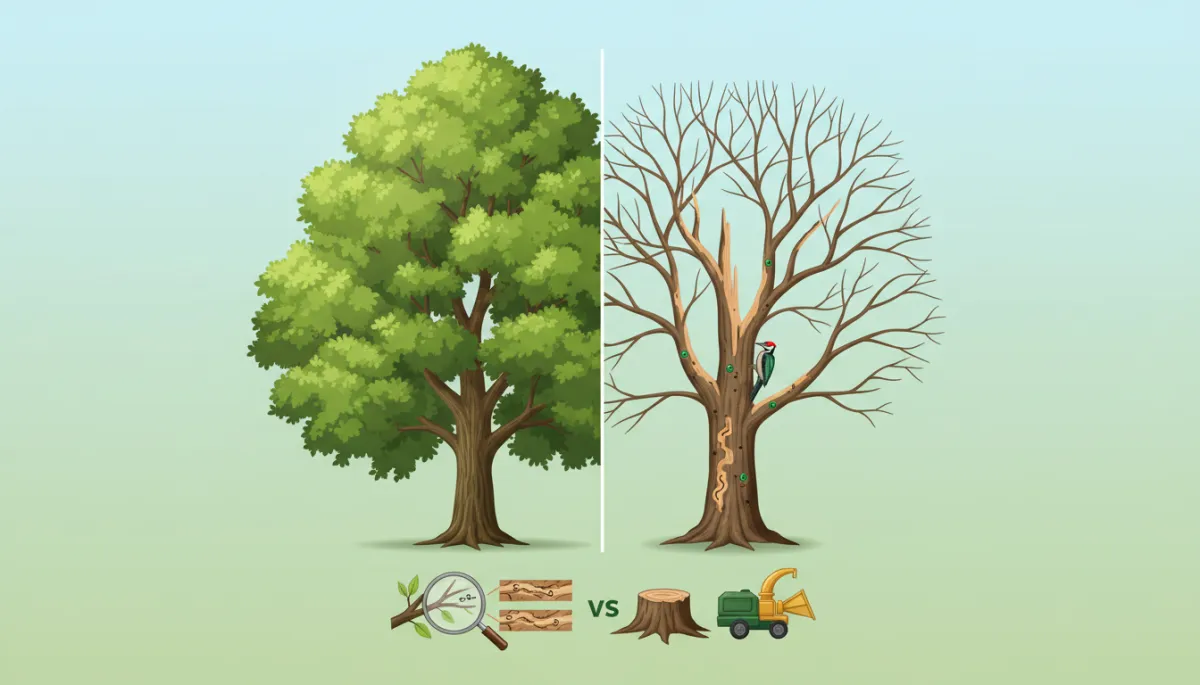
Detecting Emerald Ash Borer in Colorado Ash Trees
Tree Care, Emerald Ash Borer, Colorado, Ironwood Earthcare
Emerald Ash Borer in Colorado: How to Tell If Your Ash Tree Is Infested
By Derek Stroden, Founder & ISA Certified Arborist, Ironwood Earthcare
Emerald ash borer (EAB) has steadily spread across Colorado’s Front Range and beyond since it was first detected in Boulder in 2013 (Colorado State Forest Service, 2025–2026 reports). If you have an ash tree in your yard, early detection is the difference between saving a valuable tree and facing an expensive removal. This guide walks you through the key warning signs, what to do if you suspect EAB, and how Ironwood Earthcare can help you make the right call for your property and budget.

Why Emerald Ash Borer Matters in Colorado Right Now
As of 2026, emerald ash borer has been confirmed in numerous Colorado communities, including Denver, Aurora, Golden, Littleton, Carbondale, Berthoud, Edgewater, Wheat Ridge, and most recently Ken Caryl (Colorado State Forest Service, 2025–2026). Once EAB arrives in a community, every untreated ash tree is at risk. Nationally, this tiny metallic-green beetle has killed tens of millions of ash trees, and it can do the same here if we ignore the early warning signs.
📌 Key Takeaway: If you live anywhere along Colorado’s Front Range or in communities where EAB has been confirmed, you should assume your ash tree is at risk and start monitoring it every season.
First Things First: Is Your Tree a True Ash (Not Mountain Ash)?
Emerald ash borer only attacks true ash trees in the genus Fraxinus. It does not infest mountain ash (Sorbus), which is a completely different species despite the name. Knowing what you have is the first step before worrying about EAB.
True ash (Fraxinus): Opposite branching (twigs and buds come out in pairs directly across from each other), compound leaves with multiple leaflets (usually 5–9) attached along a central stem, and seeds that look like single “paddle-shaped” samaras.
Mountain ash (Sorbus): Typically has alternate branching and clusters of showy berries. EAB does not attack these trees.
💡 Pro Tip: If you are unsure whether your tree is a true ash, schedule a quick ID visit. At Ironwood Earthcare, we can confirm your species and risk level in minutes.
Early Signs of Emerald Ash Borer in Colorado Ash Trees
One of the biggest challenges with emerald ash borer is that serious internal damage happens before obvious symptoms appear. The larvae feed beneath the bark, cutting off the tree’s ability to move water and nutrients. By the time the signs below are noticeable, the tree may already be several years into an infestation. That’s why regular, informed inspections are so important.
1. Canopy Thinning and Dieback (Top of the Tree Looks Sparse)
One of the earliest visible signs is thinning in the upper canopy. You may notice:
Fewer leaves at the very top of the tree.
Branch tips that leaf out later than the rest of the neighborhood trees.
Sections of the crown that look bare or “see-through” when you stand back.
Canopy thinning can be caused by drought, root issues, or other insects as well, so it is not proof of EAB on its own. But in areas where emerald ash borer has been confirmed, thinning should always prompt a closer inspection.
2. D-Shaped Exit Holes on the Bark
When adult emerald ash borers emerge from beneath the bark, they chew a distinctive D-shaped exit hole about 1/8 inch wide. These holes:
Are flat on one side and rounded on the other (like a capital “D”).
Typically appear on the trunk or larger branches.
May be easier to see on smooth bark or sunlit sides of the tree.
Other insects can leave round or irregular holes, but that crisp D-shape is highly characteristic of EAB. If you see multiple D-shaped holes on a true ash, it is time to call a certified arborist.
3. S-Shaped Tunnels (Galleries) Under the Bark
The real damage from emerald ash borer comes from the larvae feeding just beneath the bark. They create serpentine, S-shaped tunnels (called galleries) packed with sawdust-like frass. These tunnels:
Meander back and forth across the trunk and branches.
Disrupt the tree’s ability to move water and nutrients.
Are usually only visible if bark is peeled back or split away.
Homeowners do not need to strip bark themselves—this is something we assess during a professional evaluation. But if you see exposed wood with winding, S-shaped tracks, that is a strong indicator of EAB activity (USDA & Purdue Extension).
4. Epicormic Sprouts (New Shoots on the Trunk or Base)
As the upper canopy begins to fail, ash trees often respond by sending out epicormic sprouts—clusters of small, leafy shoots that grow from the trunk, large branches, or even the base of the tree. These sprouts are the tree’s attempt to survive by pushing out new growth closer to where resources are still moving.
While epicormic growth can occur from other stresses, when you see trunk sprouts combined with canopy thinning in a known EAB area, it is a major red flag.
5. Bark Splitting and Cracks
As larvae feed and the tree reacts, you may see vertical splits in the bark. These splits sometimes reveal the S-shaped galleries underneath. On some trees the bark may start to flake off or appear loose in sections, especially on the sunny side of the trunk where temperature changes are more extreme.
6. Increased Woodpecker Activity and Bark Pecking
Woodpeckers love emerald ash borer larvae. An infested ash tree often shows:
Frequent woodpecker visits, especially in winter when larvae are present under the bark.
Patches of lighter-colored bark where birds have chipped away the outer layer (sometimes called “flecking”).
Woodpecker damage alone does not confirm EAB, but in combination with other signs, it is another important clue. The USDA and Purdue Extension both list increased woodpecker activity as a common early indicator of emerald ash borer infestations.
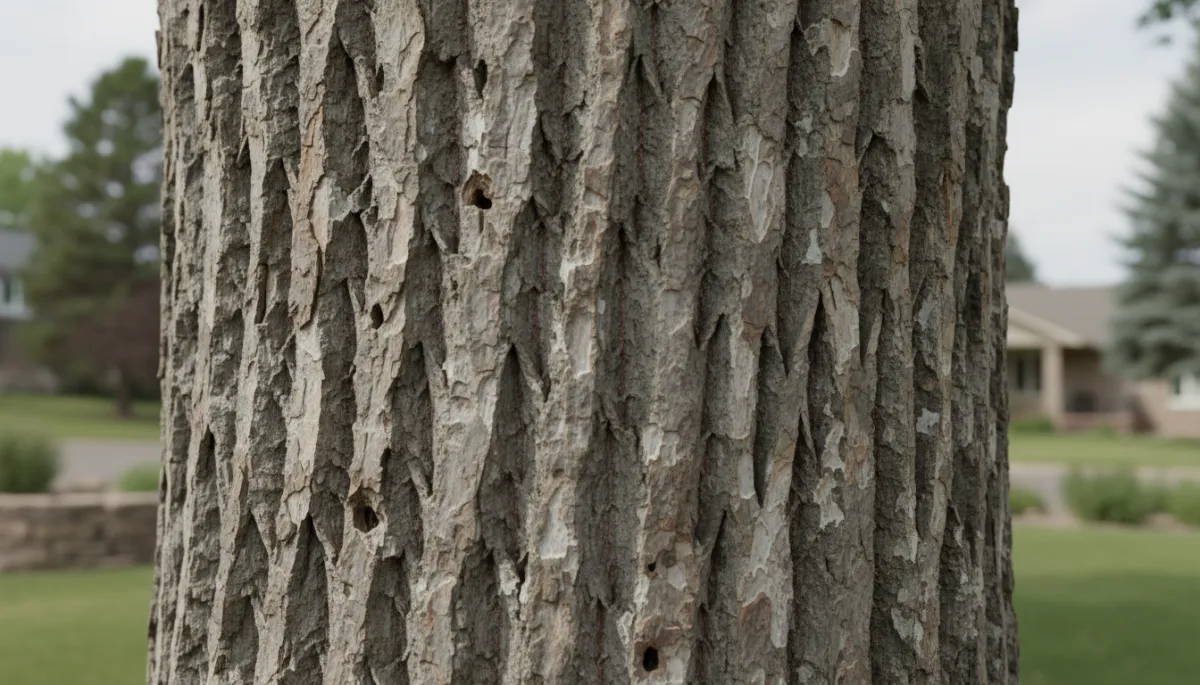
Small D-shaped exit holes and bark flecking are subtle but critical early emerald ash borer clues.
Why Early Detection Is So Important
By the time an ash tree has lost half of its canopy, the internal damage from emerald ash borer is often extensive. At that point, even aggressive treatments may not be able to restore the tree to health. On the other hand, catching EAB early—while the tree is still mostly full and structurally sound—gives us a real chance to save it.
Early-infested, otherwise healthy ash: Often respond very well to professional trunk injections and can be maintained for many years, even in areas where EAB is established.
Heavily infested trees with major dieback: Frequently become safety hazards and must be removed, especially near homes, streets, or play areas.
📌 Key Takeaway: Treating an early-infested, healthy ash can save the tree and preserve shade and property value. Waiting until the tree is in advanced decline usually means removal is the only safe option.
Treatment Options for Emerald Ash Borer in Colorado
Not every ash tree should be treated, and not every treatment is appropriate for every situation. We look at tree size, health, location, and your goals before recommending a plan. Here are the main approaches used across Colorado, aligned with guidance from the Colorado State Forest Service and university extensions.
Professional Trunk Injection (Most Common for Valuable Ash Trees)
For medium to large landscape ash trees, systemic trunk injections by a licensed applicator are the gold standard. Products such as emamectin benzoate and others are injected directly into the tree’s vascular system, where they are taken up into the canopy and target EAB larvae as they feed.
Typically protects the tree for 2–3 years, depending on product and conditions.
Requires specialized equipment and training to avoid injury to the tree and ensure even distribution.
While exact 2026 pricing varies, national extension data suggests professional injections often range from roughly $200–$500 per tree per treatment, depending on size and access. For a mature shade tree you value, this can be far less than removal and replacement over time.
Soil Drench and Granular Treatments
Some insecticides can be applied as a soil drench or granular product around the base of smaller ash trees. The tree’s roots absorb the treatment and move it through the vascular system. These options can be less expensive per application but often need to be applied annually and may not be sufficient for larger trees or heavy infestations.
Biological Controls and Community Programs
On a broader scale, agencies in Colorado have released beneficial parasitoid wasps that prey on EAB larvae. These efforts, coordinated by state and federal partners, are designed to help reduce populations over time but are not a stand-alone solution for protecting individual yard trees. Homeowners still need to decide whether to treat or remove their own ash trees.
When Removal Is the Best (and Safest) Option
If an ash tree is already in advanced decline—extensive canopy dieback, large dead limbs, or structural issues—treatment is unlikely to bring it back. In these cases, removal is often the safest and most responsible option, especially near homes, driveways, or public spaces.
Dead and dying ash trees become brittle and hazardous, making removal more complex and urgent.
Proper disposal (chipping, timely transport) is critical to avoid spreading EAB to new areas, in line with Colorado State Forest Service guidelines.
💡 Pro Tip: The best candidates for treatment are ash trees that are still structurally sound, with less than about 30–40% canopy decline. Beyond that point, removal is usually more cost-effective and safer.
Treatment vs. Removal: Cost Comparison Over Time
One of the most common questions we hear is, “Should I keep paying to treat this tree, or just remove it?” While exact numbers vary by tree size and site, here is a general comparison based on extension research and industry experience:
Treatment costs: Professional injections for a typical residential ash often fall in the hundreds of dollars per treatment range and may be needed every 2–3 years. Over a decade, you might invest a few thousand dollars to protect a large, well-placed shade tree.
Removal costs: Removing a mature ash can range from roughly $700 to $1,500 or more depending on size, access, and hazards (national extension estimates). Stump grinding and replacement planting add to that cost.
For many homeowners, especially when the tree provides significant shade, privacy, or curb appeal, ongoing treatment is still less expensive than losing the tree, paying for removal, and waiting years for a replacement to catch up. During our on-site visit, we walk you through both scenarios so you can make a fully informed financial decision.
How Fast Does Emerald Ash Borer Kill an Ash Tree?
Another frequent question is about the speed of damage. EAB does not typically kill an ash tree in a single season. Instead, damage builds over several years:
Year 1–2: Initial infestation. Little or no visible symptoms; larvae are feeding under the bark.
Year 2–4: Canopy thinning, epicormic sprouts, bark splitting, and woodpecker activity become noticeable as more of the vascular system is damaged.
Year 4–6 (or sooner in heavy infestations): Large limbs die, the canopy may be more dead than alive, and the tree can quickly become hazardous.
Local conditions and beetle pressure matter—a heavily infested neighborhood can see trees decline more quickly. The key is that you cannot wait until the tree looks terrible to act. By then, options are limited and removal is often the only safe choice.
Can I Treat Emerald Ash Borer Myself? Self-Treatment Limitations
Home improvement stores carry products labeled for emerald ash borer, and some homeowners consider a do-it-yourself approach. While these products can have a place for small, low-value ash trees, there are important limitations to understand:
Most DIY products are soil drenches or granules, which are generally less effective on large trees or in heavy infestations than professional trunk injections.
Incorrect dosing, timing, or application can reduce effectiveness and may increase environmental risk, particularly near water or pollinator plants.
Some of the most effective active ingredients and application methods (such as certain trunk injections) are restricted to licensed professionals.
📌 Key Takeaway: For mature, high-value ash trees, DIY treatments are rarely enough. A professional plan gives your tree the best chance of surviving EAB while protecting people, pets, and the environment.
Frequently Asked Questions About EAB in Colorado
How quickly will EAB kill my ash once it’s in my neighborhood?
Once emerald ash borer is established in an area, untreated ash trees often start showing noticeable decline within a few years. Most will die within about 4–6 years of significant infestation, sometimes faster in areas with very high beetle populations. Preventive treatment can dramatically slow or prevent this decline.
Is it cheaper to treat my tree or remove it?
In the short term, a one-time removal can look less complicated: you pay once and the problem is gone. But when you factor in:
The cost of removal and stump grinding (often $700–$1,500+).
The cost of purchasing and planting a new tree.
The loss of shade, privacy, and property value for years to come.
it often makes financial sense to treat a healthy, well-placed ash instead. Our role is to help you run the numbers for your specific tree so you are not guessing.
Can I just wait and see what happens before deciding?
Waiting is a decision in itself. Because EAB damage starts inside the tree, by the time severe symptoms appear, treatment options are limited and sometimes no longer effective. If EAB has been confirmed in your community and you want to keep your ash, it is wise to act before the tree looks badly damaged.
Free, No-Obligation Emerald Ash Borer Assessment with Ironwood Earthcare
As an ISA Certified Arborist and founder of Ironwood Earthcare, I believe homeowners deserve clear, honest information before making big decisions about their trees. That is why we offer a free, no-obligation EAB assessment for ash trees in our Colorado service area.
Confirm whether your tree is a true ash and at risk from emerald ash borer.
Inspect for early signs: canopy thinning, D-shaped exit holes, S-shaped galleries, epicormic sprouts, bark splitting, and woodpecker activity.
Discuss your options: proactive treatment, monitoring, or removal and replacement if the tree is already in advanced decline.
You will receive a straightforward recommendation tailored to your tree, your property, and your budget—no pressure, no surprise add-ons.
Contact Ironwood Earthcare Today
Ready to find out where your ash tree stands? Reach out to schedule your free emerald ash borer assessment:
Phone: 303-366-3020
Email: [email protected]
Website: www.ironwoodearthcare.com
💡 Pro Tip: Even if you are not ready to commit to a long-term treatment plan, a quick professional assessment establishes a baseline. You will know what to watch for and how urgent your situation really is.
Protecting Colorado’s Ash Trees, One Yard at a Time
Emerald ash borer is here to stay in Colorado, but losing every ash tree is not inevitable. With early detection, informed decisions, and appropriate treatment, many ash trees can continue to provide shade and beauty for years to come. Whether your priority is preserving a beloved tree or planning a safe, budget-conscious removal and replacement, Ironwood Earthcare is here to help you navigate your options with confidence.


